
How to Compare Two Holiday Destinations
A good destination comparison starts by fixing the same trip assumptions for both options, then checking cost, travel time, seasonality, entry rules, health requirements and on-the-ground practicality in the same order before scoring anything.
Overview
Comparing two holiday destinations works best when you apply the same checks in the same order, with the same assumptions, before any scoring begins. The useful comparison is not the headline fare but the full trip outcome: total trip cost, door-to-door travel time, seasonal suitability, connection risk, entry and health requirements, and how easy the place will be to use once you arrive.
That matters because the airfare shown by an airline is only one part of the trip. Airlines must show the full and final airfare with mandatory taxes, fees and charges, but that still leaves out many destination costs such as baggage, accommodation, airport transfers, local transport, city taxes and activity spending.
It also helps to be precise with travel language. What many travellers really need to compare is non-stop flight time, transfer time and waiting or friction in the itinerary. A direct flight should not be treated as automatically meaning non-stop, because a direct flight can still involve a stop.
This framework is useful because it is not trying to review destinations. Instead, it gives you a consistent way to compare any two places using the same logic each time.
Key definitions
Step by step walkthrough
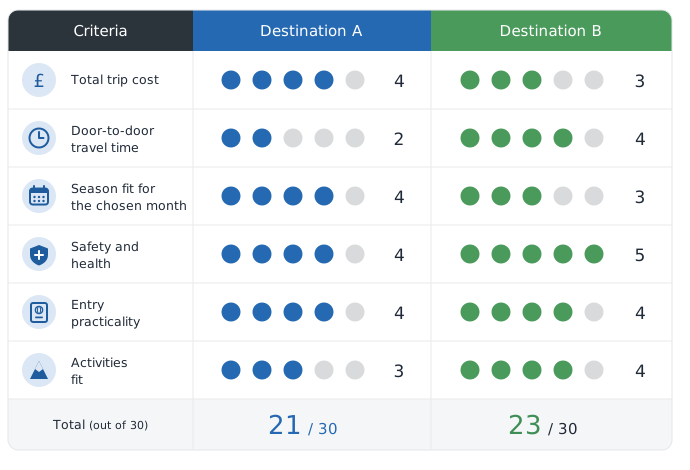
Only score the destinations once the facts are lined up on the same assumptions. Use one grid for both options with the same weightings. A simple 1 to 5 score per category is enough if the underlying comparison is consistent.
The comparison loop
Use the same loop for both destinations, then repeat it if any assumption changes. That keeps the comparison fair and makes it easier to spot which difference really matters.
Worked examples
These examples show how the comparison method works when the same assumptions are applied to both destinations. Where the research report identified source gaps, the examples keep those points clearly labelled as planning assumptions rather than verified destination facts.
Compare two European city breaks using total trip cost, flight time, transfers and weather assumptions.
| Item | Value |
|---|---|
| Barcelona total trip cost | £743.00 |
| Rome total trip cost | £722.00 |
| Barcelona flight time each way | 130 minutes |
| Rome flight time each way | 155 minutes |
| Barcelona airport-to-centre transfer | 32 minutes |
| Rome airport-to-centre transfer | 32 minutes |
| Cost difference | £21.00 |
| Cheaper option on these assumptions | £21.00 |
Compare two beach destinations and show what changes when seasonality, transit complexity and health requirements differ.
| Item | Value |
|---|---|
| Mauritius total trip cost | £2,105.00 |
| Dominican Republic total trip cost | £1,945.00 |
| Mauritius elapsed journey each way | 15.5 hours |
| Dominican Republic elapsed journey each way | 13.1667 hours |
| Mauritius November rainfall | 82 mm |
| Mauritius November rain days | 10 days |
| Mauritius November mean maximum temperature | 27.1°C |
| Mauritius November sunshine | 7.3 hours per day |
| Cost difference | £160.00 |
| Cheaper option on these assumptions | £160.00 |
Checklists
Use these checklists to keep your comparison consistent and to make sure nothing important is missed before booking.
Destination comparison checklist
Booking readiness checklist
Glossary
- Total trip cost
The combined cost of all fixed and likely trip components needed to complete the holiday as planned.
- Headline fare
The advertised airfare before adding other trip elements such as baggage, accommodation, taxes on stays, transfers and spending on the ground.
- Non-stop flight
A flight with no intermediate stop between departure and arrival. This is usually the cleanest measure for comparing air travel time.
- Direct flight
An airline term that may differ from non-stop and can include a stop while keeping one flight number. It should not be assumed to mean the same as non-stop.
- Indirect travel time
Time added by connections, layovers, transfer waiting, border checks and airport-to-centre movements.
- Connection risk
The operational risk that a transfer causes delay, missed onward travel, baggage problems or weak disruption protection.
- Seasonality
The repeating annual pattern that affects weather, prices, opening patterns and crowd levels.
- Shoulder season
The period between peak and low season, often balancing cost and conditions, but only useful if the monthly weather still fits the trip purpose.
- Entry requirements
Border conditions such as passport validity, visa rules, digital forms, onward ticket expectations and health documentation.
- On-the-ground logistics
The systems that affect practical ease after arrival, including airport transfer options, public transport, payment access and local movement.
Verified callouts
Headline fare versus total trip cost
Airlines must display the final airfare with mandatory taxes, fees and charges, but that number does not include most destination costs. A proper destination comparison should add baggage, accommodation, local taxes, transfers, insurance and essential on-the-ground spending before deciding which trip is cheaper.
Travel advisories, entry rules, and health requirements can change the decision
Official travel advice covers entry requirements, health advice and safety information, and these checks can alter which destination is simpler or even viable. Health rules can also depend on routing, not only destination, as shown by yellow fever requirements that may apply after transit through certain locations.
Seasonality and connection risk can outweigh small price differences
Monthly climate normals and official climate statistics give a better basis for comparison than general impressions of a destination. Connection design also matters: a small saving can disappear if a longer or self-transfer itinerary increases delay exposure or weakens missed-connection protection.
Internal links
Definitions
- What Total Trip Cost Means in Travel Planning
- Direct Flight vs Non-stop Flight
- How to Measure Door-to-door Travel Time
- What Connection Risk Means
- Single Ticket vs Self-transfer
- What Shoulder Season Means
- How to Read Climate Normals for Travel
- Entry Requirements Explained
- Travel Advisories Explained
- Travel Health Requirements Explained
- Airport Transfer Time Explained
- Tourist Taxes and Accommodation Taxes Explained
- Why Monthly Weather Matters More Than Annual Averages
- Booking Readiness Checklist
- Travel Insurance Basics for Trip Comparison
Sources
- About Foreign, Commonwealth & Development Office travel advice
- Foreign travel checklist
- Foreign travel insurance
- Your finances when travelling abroad
- Planning your trip
- Delays
- Flight delays and cancellations
- Consumer travel advice Summer 2026
- Air passenger rights
- Understanding Climate Normals
- U.S. Climate Normals
- Vaccines and travel
- Mauritius traveller view
- Dominican Republic traveller view
- Yellow fever guidance
- Mauritius travel requirements
- Tourist entry basics
- Climate table
- E-ticket service
- Entry requirements
- FAQs
- Travel tips
- Airport metro access
- Fiumicino train access
- Leonardo Express
- Tax on stays in tourism establishments
- Contributo di soggiorno
- Climate values
- Direct vs non-stop flights guide