
Airport to Accommodation
A practical guide to choosing the right airport-to-accommodation transfer by comparing total journey time, luggage effort, payment rules, legitimacy checks, booking needs, and backups.
Overview
Airport to accommodation transfer is the first ground journey after landing, from the terminal to the place you are staying. Common options include rail, metro, bus, shuttle, licensed taxi, rideshare, hotel transfer, and pre-booked private transfer. Each differs on walking distance, waiting time, luggage effort, payment method, availability, and how easy it is to confirm that the operator is legitimate.
A good choice usually comes from a short decision loop, not from taking the cheapest headline fare at face value. The useful comparison is total journey time from terminal exit to the property, including immigration and baggage delay, the walk to the station or pickup point, queueing, service frequency, interchange effort, luggage handling, and whether the option still works if the flight lands late.
Safety matters because airports often separate official rank taxis, pre-booked private hire, and app-based pickups into different zones. Official guidance commonly tells passengers to follow airport signs to the authorised rank or designated pickup area and to avoid accepting rides from people who approach inside the terminal.
Cost matters in a similar way. Some systems use metered fares, some use fixed fares on certain routes, and some add airport or congestion surcharges. This guide focuses on the transferable mechanics that help across destinations: how to compare the options, how to read the fare structure, when advance booking matters, and how to build a backup plan.
Definitions
Step by step walkthrough
Use a full journey comparison rather than in-vehicle time alone.
Total transfer time = terminal exit walk + waiting time + in-vehicle time + interchange time + final walk to the property.
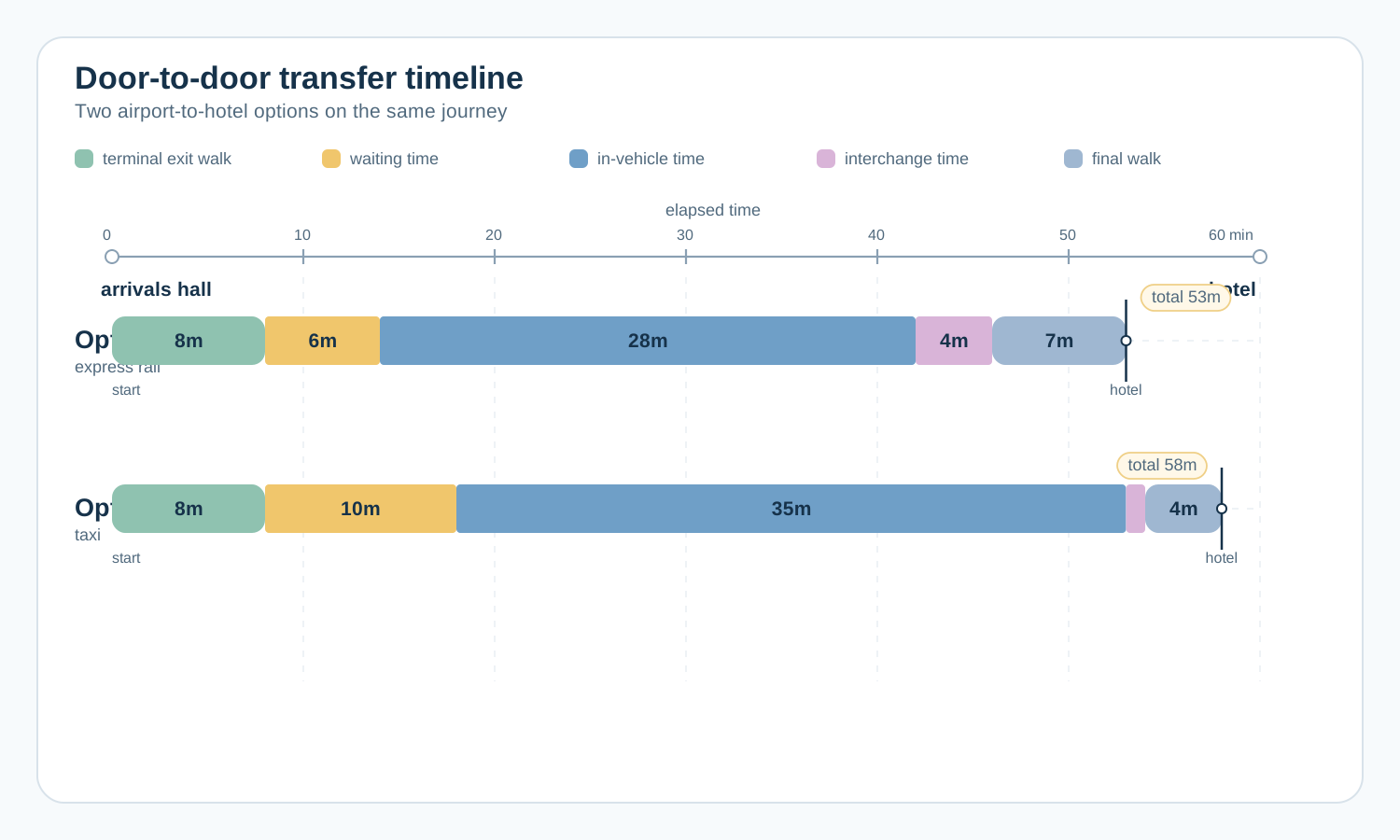
This matters because public transport can have low in-vehicle time but high interchange effort, while taxis can remove interchanges but vary with traffic. Express rail is often fastest in the vehicle, metro slower but cheaper, and coach sometimes attractive mainly because of stop location rather than speed.
The decision loop
A simple airport transfer decision loop helps you compare what looks cheapest with what will actually work after landing. The important point is that each extra interchange, each extra bag, and each late-night variable increases the value of direct door-to-door transport.
Worked examples
These examples show how the same route can look different once time, luggage, and total cost are compared properly.
Compare express rail with airport coach for a daytime arrival where the headline fare is the same.
| Item | Detail | Value |
|---|---|---|
| Travellers | One traveller | 1 |
| Arrival time | Arrival at 14:00 | 14:00 |
| Bags | One cabin bag and one medium suitcase | 2 items |
| Walk from rail station to property | Accommodation is 600 metres from the rail station | 600 metres |
| Walk from coach stop to property | Accommodation is 200 metres from the coach stop | 200 metres |
| Rail walk from arrivals to station | Option A | 10 minutes |
| Rail average wait | Option A (assumption) | 7 minutes |
| Rail journey | Option A | 15 minutes |
| Rail final walk to property | Option A | 12 minutes |
| Rail fare | Option A, based on Heathrow Express starting price assumption | £10.00 |
| Rail total time | Option A | 44 minutes |
| Rail total cost | Option A (assumption) | £10.00 |
| Coach walk from arrivals to stop | Option B | 6 minutes |
| Coach average wait | Option B (assumption) | 15 minutes |
| Coach journey | Option B | 45 minutes |
| Coach final walk to property | Option B | 4 minutes |
| Coach fare | Option B, based on Heathrow coach pricing starting price assumption | £10.00 |
| Coach total time | Option B | 70 minutes |
| Coach total cost | Option B (assumption) | £10.00 |
| Time difference in favour of rail | 26 minutes | |
| Item | Detail | Value |
|---|---|---|
| Travellers | Two travellers | 2 |
| Rail fare | Shared plan base fare (assumption) | £10.00 |
| Short taxi from rail station | Added city-end taxi (assumption) | £8.00 |
| Combined total cost | Rail plus short taxi (assumption) | £18.00 |
| Per-person cost | Two travellers sharing (assumption) | £9.00 |
| Estimated total time lower end | Depending on taxi queue (assumption) | 38 minutes |
| Estimated total time upper end | Depending on taxi queue (assumption) | 42 minutes |
| Per-person cost | £9.00 | |
Compare late-night direct vehicle options where certainty, luggage, and check-in timing matter more than the lowest possible fare.
| Item | Detail | Value |
|---|---|---|
| Travellers | Two travellers | 2 |
| Arrival time | Arrival at 23:30 | 23.5 hours |
| Free-flow journey time | Destination 35 minutes from airport | 35 minutes |
| Large suitcases | Two large suitcases | 2 |
| Cabin bags | Two cabin bags | 2 |
| Reception closing time | Accommodation reception closes at 01:00 | 1:00 |
| Taxi walk to rank | Option A | 5 minutes |
| Taxi queue | Option A | 10 minutes |
| Taxi journey lower end | Option A (assumption) | 35 minutes |
| Taxi journey upper end | Option A (assumption) | 55 minutes |
| Taxi fare lower end | Option A including likely extras (assumption) | £55.00 |
| Taxi fare upper end | Option A including likely extras (assumption) | £75.00 |
| Rideshare walk to pickup zone | Option B | 12 minutes |
| Rideshare request and driver approach lower end | Option B (assumption) | 8 minutes |
| Rideshare request and driver approach upper end | Option B (assumption) | 20 minutes |
| Rideshare journey lower end | Option B (assumption) | 35 minutes |
| Rideshare journey upper end | Option B (assumption) | 55 minutes |
| Rideshare fare lower end | Option B depending on demand (assumption) | £48.00 |
| Rideshare fare upper end | Option B depending on demand (assumption) | £82.00 |
| Private transfer meet-and-greet wait lower end | Option C after baggage claim (assumption) | 0 minutes |
| Private transfer meet-and-greet wait upper end | Option C after baggage claim (assumption) | 5 minutes |
| Private transfer journey lower end | Option C (assumption) | 35 minutes |
| Private transfer journey upper end | Option C (assumption) | 55 minutes |
| Private transfer fixed fare | Option C agreed before arrival | £68.00 |
| Pre-booked transfer fixed fare | £68.00 | |
Checklists
Use these lists to turn the decision loop into a practical arrival plan.
Pre-arrival transfer checklist
Arrival and pickup readiness checklist
Glossary
- Rail
A train service from the airport, often express or mainline.
- Metro
Urban rapid transit, usually frequent and cheaper than airport express rail.
- Bus
Scheduled road service, sometimes local stop-based.
- Coach
Longer-distance or airport-focused bus service, often with luggage hold.
- Shuttle
Shared vehicle on a set route or roster, often serving hotels or airport clusters.
- Licensed taxi
Taxi authorised by the relevant authority and usually able to pick up from an official rank.
- Private hire / minicab
Vehicle that must generally be booked in advance under local rules, rather than hailed.
- Hotel transfer
Vehicle arranged by the accommodation.
- Pre-booked private transfer
A reserved car or van, often fixed price and sometimes meet-and-greet.
- Official taxi rank
The airport-designated queueing point for authorised taxis.
- Metered fare
A fare calculated by the taximeter according to regulated tariff rules.
- Fixed fare
A set price for a route, zone, or booking.
- Airport surcharge
An additional airport-related fee added to the fare in some systems.
- Meet-and-greet
A pre-arranged pickup where the driver or representative waits in arrivals.
Verified callouts
Official taxi rank versus unofficial solicitation
Use the airport’s signposted taxi rank or your app’s designated pickup area, not unsolicited offers inside arrivals. Official airport and government guidance repeatedly separates authorised rank or pickup systems from unauthorised solicitation, and some airports explicitly prohibit drivers from soliciting passengers on airport property.
Fixed fare, metered fare, and airport surcharge differences
A fixed fare is a published or pre-agreed price for a route or booking, while a metered fare is calculated during the journey under regulated tariffs. Airport and congestion surcharges can still sit on top of either model, so the final price may be higher than the advertised base fare.
When advance booking matters for airport transfers
Advance booking matters most when certainty is more valuable than flexibility: late arrivals, heavy luggage, larger groups, remote destinations, and time-sensitive check-in. Official airport and platform guidance supports this by showing that private transfers can include terminal meet-and-greet, while rideshare and rank pickups may depend on designated zones, queueing, or local airport rules.
Internal links
Definitions
- Airport transfer types explained
- Official taxi rank vs private hire vs rideshare
- Metered fares, fixed fares, and airport surcharges explained
- How airport rideshare pickup zones work
- How to assess luggage friction on public transport
- Meet-and-greet airport transfers explained
- Late-night arrival transport planning
- How to verify a legitimate airport transfer operator
Sources
- By taxi or mini cab
- Getting to Central London
- Train Travel with Luggage
- Pickups
- Washington Dulles International Airport Pickup & Drop-off Directions for Rideshare
- Statutory taxi and private hire vehicle standards
- Report unlicensed taxis, minicabs or private hire vehicles
- Guide to taxis and private hire
- Taxi Fare
- Taxi fares and tariffs update 2026
- Taxis and Transfers
- To and From the Airport FAQs
- Taxi to or from Schiphol airport
- Ride Services
- Meet and Greet Services